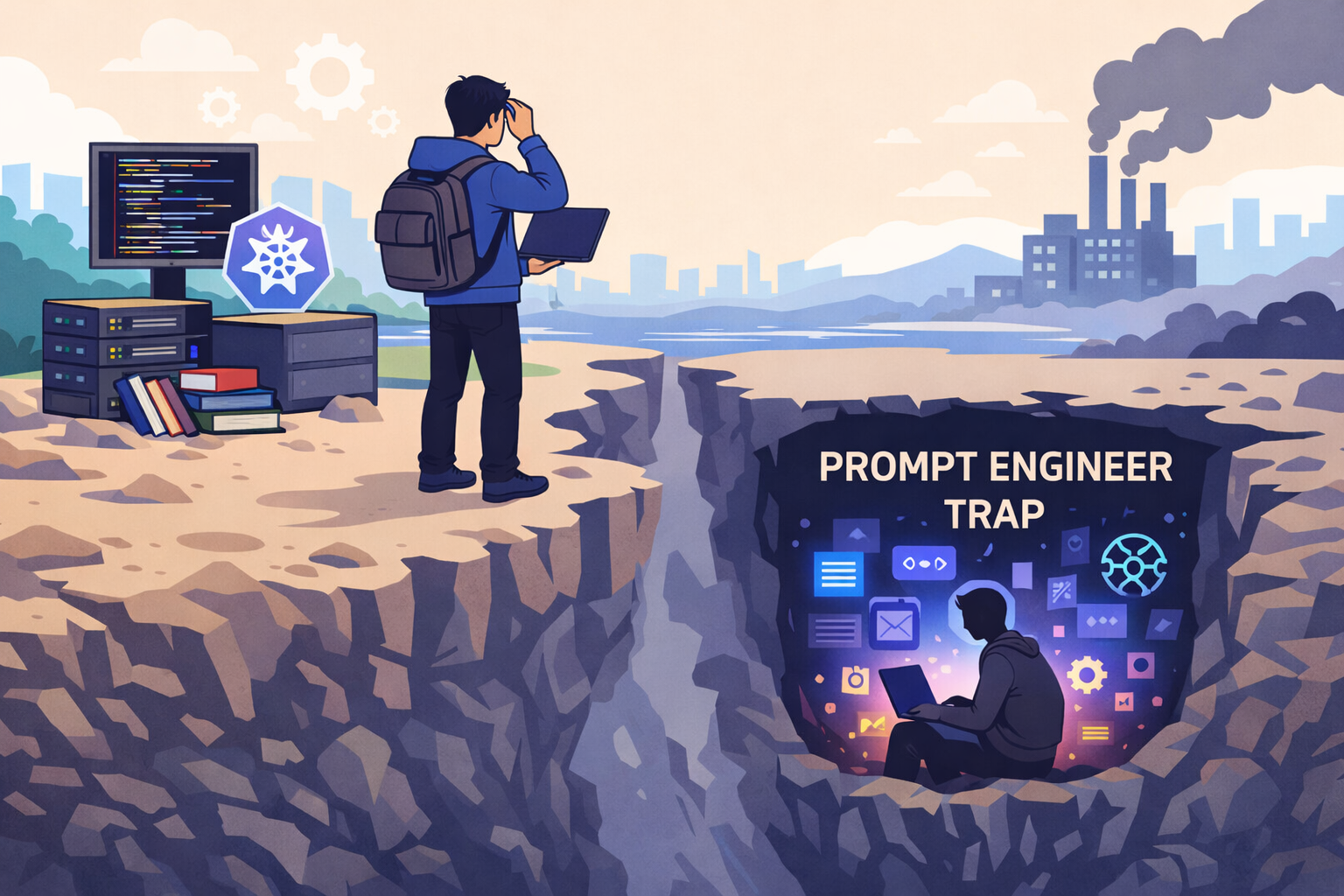
The Prompt Engineer Trap is the single greatest risk facing modern developers today. We are living in the golden age of “The Shortcut.” If you browse tech social media today, the message is clear: “Coding is dead. Long live the Prompt Engineer.” We’re told that deep knowledge of memory management, pointer arithmetic, or even basic CSS is a waste of time because an LLM can generate a solution in seconds.
But at aivinpro.com, we’re seeing a dangerous trend. We’re seeing a generation of developers who can build a dashboard in an afternoon but can’t explain how a for loop works under the hood. To avoid the Prompt Engineer Trap, you must look beyond the AI generation box and master the core engineering principles that actually run the world.
Table of Contents
1. The Illusion of Competence
When you use AI to generate code, you get a “result.” The code runs, the UI looks clean, and the client is happy. You feel like a genius.
But this is Borrowed Competence. If you don’t understand the logic behind the code, you aren’t an engineer; you’re an operator. You are essentially a middleman between a black box and a text editor. The moment the AI makes a mistake—and it will—you are helpless. The Prompt Engineer Trap is thinking that because you can request a solution, you own the skill. True engineering is about solving problems when the tools fail.
2. Why Fundamentals Still Matter (The Code Proof)
Let’s look at a simple example. Suppose you need to filter a large dataset in Python. An AI might give you a standard list comprehension because it’s “idiomatic” and easy to read.
The AI approach (The Trap):
Python
# AI-generated: Simple but memory-heavy for large data
data = range(10000000)
filtered_data = [x for x in data if x % 2 == 0]
print(filtered_data[0:5])
The Engineer’s approach (The AivinPro Way): A real coder avoids the Prompt Engineer Trap by understanding Generators and Memory Efficiency. If you’re dealing with millions of records, you don’t want to load them all into RAM. You use a generator to save resources.
Python
# The Professional approach: Memory efficient
def get_filtered_data(data):
    for x in data:
        if x % 2 == 0:
            yield x

data = range(10000000)
filtered_generator = get_filtered_data(data)

# We only pull what we need, when we need it.
for i in range(5):
    print(next(filtered_generator))
The difference? The first one might crash a low-spec production server or a cloud instance. The second one runs smoothly everywhere. AI often prioritizes “looking right” over “being right” for your specific infrastructure.
3. The Kubernetes Complexity Gap
As we often discuss, Kubernetes is the backbone of modern scaling. You can ask an AI to write a deployment.yaml, and it will give you a standard template.
But what happens when your pods keep crashing with an OOMKilled (Out of Memory) error?
- The Prompt Engineer asks the AI: “Why is my pod crashing?” and gets 10 different guesses.
- The Real Coder looks at the
resourceslimits, understands the difference betweenrequestsandlimits, and checks the heap usage.
Understanding the Kubernetes documentation is what separates a senior architect from someone falling into the Prompt Engineer Trap.
4. How to Avoid the Prompt Engineer Trap
If you want to survive the AI revolution and perhaps land a high-stakes role in Quantitative Finance or Systems Engineering, you need to be the person who audits the AI, not the person who depends on it.
Step 1: The “No-AI” Hour
Every day, spend one hour coding something from scratch. No Copilot. No ChatGPT. Just you, your IDE, and the Python documentation. This keeps your “logic muscles” from atrophying and prevents the Prompt Engineer Trap.
Step 2: Debug the AI
Whenever an AI gives you a block of code, treat it like it was written by a junior intern.
- Does it handle edge cases?
- What is the Big O complexity?
- Is it using deprecated libraries?
Step 3: Master the “Boring” Stuff
AI is great at writing syntax. It is terrible at System Architecture. Learn how databases talk to each other and how networking protocols work. Mastering these fundamentals is the best way to escape the Prompt Engineer Trap.
5. Final Thoughts
AI is a tool, like a calculator is for a mathematician. A calculator makes a mathematician faster, but it doesn’t make them a mathematician.
At aivinpro.com, we aren’t anti-AI. We are pro-intelligence. Don’t let the convenience of a prompt rob you of the skill of a creator. Use the tools to build faster, but never stop learning how the bricks are made. If you stay curious and keep building, you will never fall into the Prompt Engineer Trap.
Are you relying too much on AI lately? Be honest in the comments—let’s discuss how we can balance speed with skill.
Check out other blogs –